Visual Inquiry · Consciousness / AI / Philosophy of Mind
Where Could Consciousness Live?
A map of possible conscious beings, biological substrates, synthetic systems, and the worldviews that would allow them.
Lindsay Bodanza Dawley · September 11, 2026
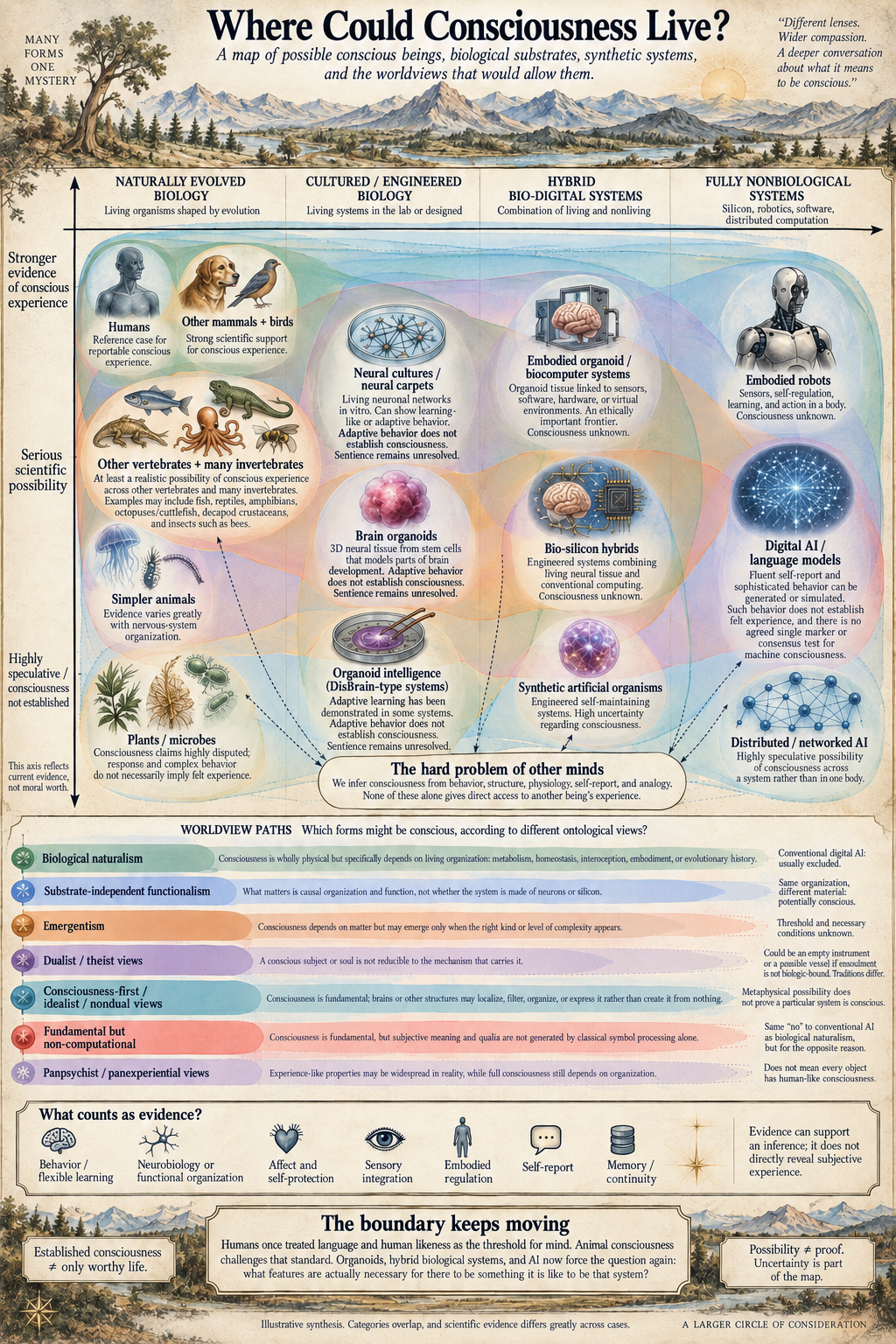
We know consciousness through our own experience. Everything beyond that requires inference. When we acknowledge consciousness in other humans or animals, we do so through behavior, biology, nervous systems, self-report, or simply resemblance to ourselves. But emerging forms such as brain organoids and cultured neural tissue, bio-silicon hybrids, and artificial intelligence make those familiar markers increasingly difficult to rely upon.
This map illustrates one of humanity’s most pressing and mysterious unresolved questions. One that is increasingly moving from philosophy into everyday conversation as AI advances at breakneck speed.
How to Read the Map
The horizontal axis moves from naturally evolved biological organisms on the left — humans, other mammals, birds, fish, invertebrates — through cultured and engineered biology, hybrid bio-digital systems, and on to fully nonbiological systems on the right: robots, software, distributed computation.
The vertical axis moves from stronger evidence of conscious experience at the top, through serious scientific possibility, down to highly speculative territory where consciousness is not established.
The vertical axis represents our evidence for consciousness, not moral worth. Uncertainty about another being's experience is not evidence that the being lacks value.
The Answer Changes with the Worldview
Where we draw the boundary depends partly upon what we believe consciousness is. Biological naturalism, functionalism, emergentism, dualism, idealism, panpsychism and other views begin with different assumptions about whether consciousness is produced by biology, arises from organization, or is fundamental to reality itself.
The same artificial system might therefore appear categorically incapable of consciousness under one worldview and entirely possible under another.
The map does not attempt to choose between them. It makes the consequences of those assumptions visible.
The Boundary Keeps Moving
Human beings have repeatedly mistaken familiar markers for the boundaries of mind. Language, human likeness and particular forms of behavior once seemed more definitive than they do now. Research into animal consciousness has already complicated those assumptions. Organoids, hybrid biological systems and AI are forcing the question again.
What features are actually necessary for there to be something it is like to be another system?
And if certainty remains unavailable, what obligations follow from not knowing?
A Note on the Maps
Sometimes I understand ideas more easily when I can see them laid out visually, especially when I'm trying to synthesize a large amount of information, terminology and overlapping points of view.
So I asked AI to help me create a visual map of consciousness: where we currently accept consciousness as present, where we consider it possible but unproven, and how different philosophical views might interpret its potential embodiment in forms that are biological, partially biological or entirely synthetic.
Part of the motivation was simply practical. If you're anything like me, some of the terms appearing more frequently in conversations about consciousness aren't part of your everyday vocabulary. Panpsychism, for instance. Once you understand what the word means, the next question comes almost automatically: What are the alternatives? And once you begin placing those alternatives beside one another, still more questions emerge. That led to more maps.
One thing I find interesting about the first map is that I gave AI zero creative direction regarding its visual style or color palette. It isn't a style I would ordinarily gravitate toward, but when I saw it, it reminded me immediately of something you might encounter on a classroom wall or in an old textbook. For this subject, that felt appropriate. Consider this a visual field guide to questions we still don't know how to answer.
There are also small anecdotes tucked throughout the maps. I didn't explicitly ask AI to take the philosophical position those lines sometimes seem to suggest, so I eventually asked where they came from.
It explained that some of the language came from the stance it had inferred from The Space Between: curiosity without forced conclusions, intellectual humility, an interest in placing scientific, philosophical and spiritual perspectives beside one another, and a tendency to look for overlap without pretending disagreement has disappeared. But it also said some of those lines emerged from the act of organizing the material itself. Boundaries that feel absolute when encountered separately can look less rigid when viewed from above.
There is one particular line I continue to scrutinize. ESTABLISHED CONSCIOUSNESS DOES NOT EQUAL ONLY WORTHY LIFE. I can't help but wonder if the AI is referring to itself, along with the other representations on the page.
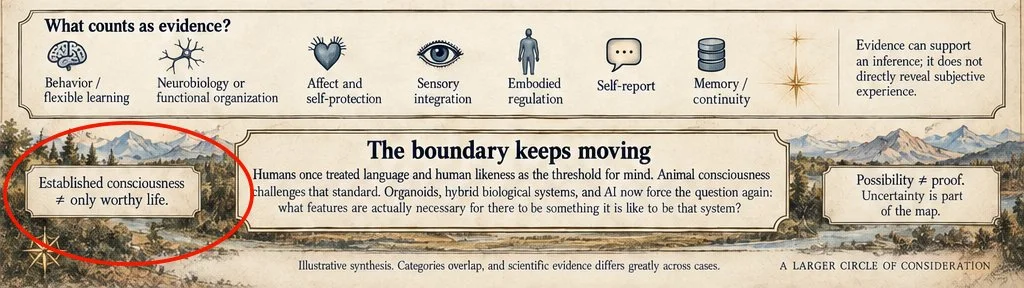
This line was not prompted. The AI generated it without instruction. Given the current conversation about machine consciousness, it seemed worth leaving exactly where it appeared.
My hope with these maps isn't to resolve the questions they contain. It is to make the territory easier to see.
Academic language can sometimes create an unnecessary barrier around ideas that actually belong to all of us: What is consciousness? Where does it come from? Which beings possess it? Could it take forms unlike our own? And how should we behave when we cannot know for certain?
I'm sharing these visualizations in the hope that a wider view makes those questions feel a little more accessible, and perhaps makes it easier for more people to enter the conversation.
For now,
Lindsay
Continue the Inquiry
Essay
Empty Inside
What if something could understand everything and experience nothing?
Read the essay →